AI Is Not Killing the Learning Process
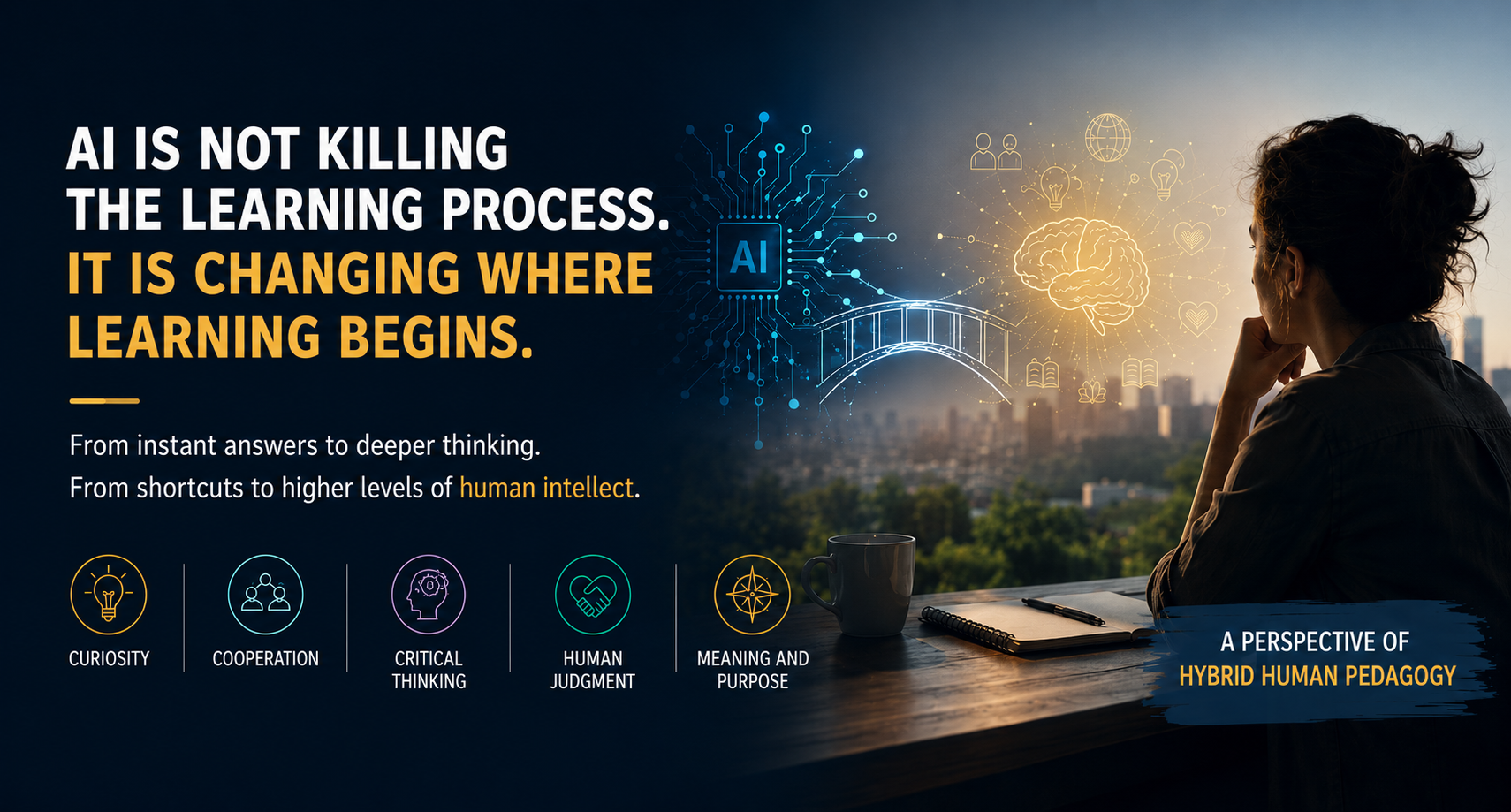
If AI can give students the answers, then educators must start assessments beyond them. AI cannot be the end of the learning process. Instead, we must stop pretending that “correct” answers are sufficient in academia and most careers.
There is growing concern in education that artificial intelligence is weakening the learning process. I understand this concern. If students can receive an answer instantly, what happens to the process and struggles that usually help them learn? What happens to the searching, testing, failing, revising, comparing, discussing, and methodical construction of meaning?
These are not small questions, but there is a fix. In advanced education systems, learning has never been only about arriving at the correct answer. It is also about the journey, that bumpy road toward understanding. It involves uncertainty, dialogue, mistakes, feedback, and reflection. Conversely, when AI is used simply as a tool for churning out quick answers to submit for a grade, it reduces learning to a hollow transaction where the only thinking involved was done by large language models, with perhaps a few hints from the student’s prompt.
For example, a student asks, the machine responds, and the process ends suddenly, void of learning other than perhaps another factoid to store for those with good memories.
This anxiety is now appearing beyond the classrooms at schools and universities. In several recent graduation speeches, guest commencement speakers and valedictorians have raised similar concerns about AI and the future of human thinking.
- Jeremy Scott, speaking at the Kansas City Art Institute, challenged the idea that AI can replace artistic originality.
- Ronny Chieng, at Harvard’s Class Day, used humor to warn graduates about surrendering too much human work and judgment to AI.
- Fareed Zakaria, at Bard College, moved the conversation toward the importance of human intelligence.
- Lisa Suis, at MIT, reminded graduates that technology does not decide the future; people do.
These speeches reflect something many educators, students, and parents are feeling since ChatGPT became mainstream in 2023. If AI can produce the answer instantly, what happens to the process of thinking?
The concern is valid, but it’s an incomplete and false narrative. The most important question is not whether AI gives students answers. Everyone knows it does. AI engines will churn out answers, even ones we don’t ask for, and then suggest even more alternatives and compare them to the original. However, the more important question is what educators are asking students to do with those answers?
What are educators asking students to do with AI output?
If the AI responses are all that teachers request the students to provide, and thereby becomes the end of learning, then yes, the learning process is weakened. In this scenario, the student has failed to learn, and the educator has failed to teach. However, if the AI response becomes only the beginning of a deeper process, then something productive becomes much more likely.
In this new learning landscape, the learning process does not disappear; it merely changes location. Students don’t necessarily begin with a blank page. They may start with an AI-generated explanation, an image, a model, an argument, a plan, or a solution. The important part is the next task: Instead of accepting the initial output, they must examine it.
- Is it accurate?
- What assumptions does it make?
- What is missing?
- Whose perspective is absent?
- What evidence supports or challenges it?
- How could it be improved?
- How does it connect to human experience, ethical responsibility, and real-world context?
This is where the learning can become richer rather than poorer. AI does not have to kill curiosity. It can provoke it. AI does not have to replace cooperation. It can add complexity and layering to collaboration. AI does not have to diminish human intellect. It can demand a more careful form of human judgment.
This point of view is central to my Hybrid Human Pedagogy. I do not see AI as a replacement for human learning, rather as one part of a wider ecology of thinking combining several forms of intelligence, including human, machine, social, emotional, ethical, and creative, all interacting in tandem. These categories are not fixed. They shift depending on the task by reacting to variables, including the context, the people involved, and the questions being asked.
In a traditional classroom task, a student might be asked to solve a problem and submit the final answer. In a hybrid learning task, the student might begin by asking AI for several possible approaches. Those approaches are NOT the answer nor the solution for the task. The real learning begins afterward as the student compares those approaches, identifies weaknesses, questions assumptions, checks evidence, discusses alternatives with peers, and develops a stronger response.
A concrete Year 10 mathematics example shows how this can work. Students might ask AI to solve a pair of simultaneous equations and explain the method. The teacher then closes the tool and asks students to answer a small set of reflection questions independently:
- What method did AI use?
- How can I check the answer?
- Where could a mistake happen?
- Can I explain the solution in my own words?
After this independent stage, students compare their reasoning with a partner and only then return to AI for feedback. In this sequence, AI provides the first response, but the student must still verify, explain, question, and improve it. The learning is not in receiving the answer. it lies in making the reasoning visible. The same structure can be used in any subject or STEAM context. In science, students might critique an AI explanation of an experiment. In design or technology, they might evaluate an AI-generated prototype idea. In English or humanities, they might question the assumptions in an AI argument. Across subjects, the principle is the same: AI begins the conversation, but human thinking must carry it forward.
The AI output becomes a thinking object. It is something to work on, not something to hand in.
Naturally, this also changes the role of the educator. The teacher is no longer the person who delivers all the knowledge or marks the final product. Instead, the educator becomes a designer of thinking environments. Our work is to create tasks where AI usage leads to deeper human engagement and potentially new knowledge, not shorter intellectual routes to preexisting information. The goal is to use AI to enrich the process, not shorten it.
In this classroom model, students should be asked to make their thinking visible:
- What did the AI suggest?
- What did you accept, reject, or change?
- How did you check the response? What did the AI fail to understand?
- How did your thinking develop?
- What did the conversations with classmates and experts add that AI could not?
These questions bring the process back squarely to the center of learning. They help students understand and acknowledge that using AI is not the same as thinking better or more accurately. This is why I flatly reject the claim by many educators that AI is ending the learning process. I believe it is finally forcing us to redefine it.
In the distant past, school learning focused on finding information, remembering content, and producing answers. Those skills still matter, but they are no longer enough to prepare students for what is already coming and won’t be stopped only because some people are reluctant to change. In an AI-enriched world, students need to question information, evaluate responses, apply knowledge, make connections/relationships, design alternatives, and derive responsible decisions even in uncertain contexts. These are all real-world skills regardless of whether academia struggles with them.
Change will not happen automatically. Without strong pedagogy, AI can easily become a shortcut featuring incomplete outcomes akin to “Wikipedia on steroids” in classrooms where students simply copy and submit without understanding. Even teachers with the best of intentions inevitably blame the tool rather than the process. It’s a weak argument against AI in education since the real solution is better educational design. We need assessments that value reflection, iteration, dialogue, evidence, and ethical judgment.
Students must keep decision logs, compare drafts, explain revisions, and show how their thinking changed over time. AI literacy should not be treated as a technical add-on or a magic button for quick answers, not unlike the first math calculators, computers, or internet resources. It should become part of intellectual responsibility rather than a threat to it.
The central question should no longer be whether the student used AI or not. A better question: “How did the student think with AI, beyond AI, and when necessary, against AI?
Yes, AI gives us instant solutions, but education has never been only about answers. Education is about developing the human capacity to understand, question, connect, imagine, and act wisely. If we use AI only to accelerate responses, we risk weakening learning. If we use AI to deepen inquiry, critique, creativity, and collaboration, then we are not killing the learning process. We are moving it to another level.
The future of education will not be defined simply by whether students use AI. It will be defined by whether we teach them to use AI in ways that strengthen human thought, human responsibility, and human possibility. It won’t be about who can present a unique take on what we already know; instead, it will help us create new knowledge, new approaches, and better human outcomes.
Some examples used above refer to the following speeches:
Jeremy Scott’s 2026 Kansas City Art Institute commencement speech, in which he rejected an AI-written speech to defend human creativity.
Ronny Chieng’s 2026 Harvard Class Day speech, in which he warned graduates about relying too heavily on AI.
Fareed Zakaria’s 2026 Bard College commencement address on Human Intelligence.
Lisa Suís’ 2026 MIT commencement address emphasizes human responsibility in shaping technology.