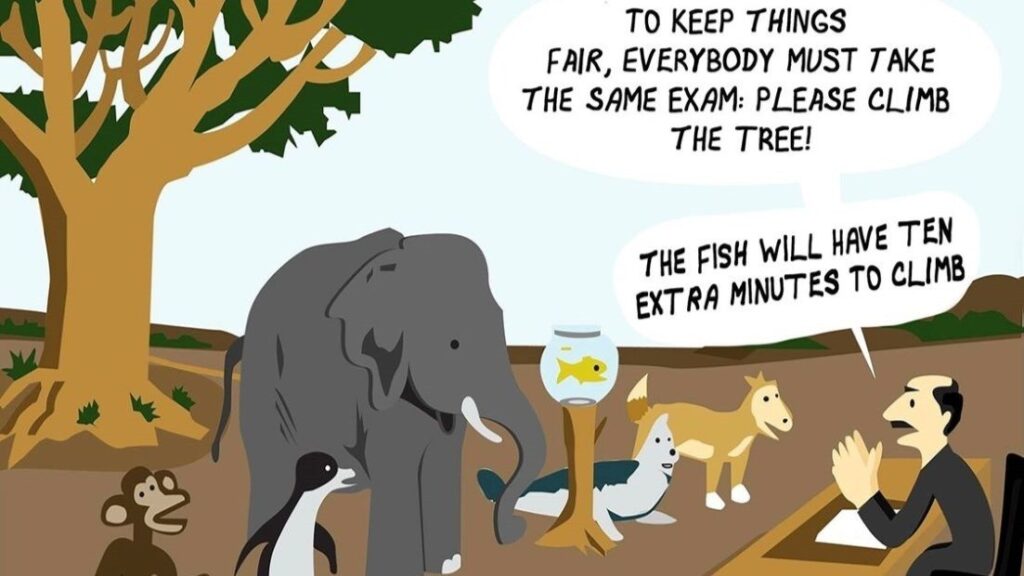
If a fish cannot climb a tree, perhaps the actual problem is the tree, not the fish. Some insist that the tree must be climbed the same way to ensure equitable evaluation of learning. In the real world, no matter how much extra time you allot, the fish will still not be able to climb the tree.
I recently pulled up this classic image depicting one prevalent train of thought in our education system. A teacher asks a monkey, penguin, elephant, fish, sea lion, and dog to perform the equal task of “climbing a tree,” while the fish is given “10 extra minutes” to complete the task, seemingly as a nod to keeping things inclusive and fair….
The scene is amusing, but it’s also painfully true. For too long, we’ve tried to make education assessment equitable by simply adjusting time allowed for different students to complete tests or assignments rather than rethink the entire process of assessment itself. Somehow, consensus seemed to evolve to a point where the allotment of more time alone was deemed sufficient to account for profound variances in the way different students learn and demonstrate knowledge. This made me wonder; what if students could “shape their own evaluation” in ways that highlight their individual strengths while still being held accountable for proving their grasp of the desired core outcomes?
Rethinking Assessment for Agency and Inclusion
As a pilot, I created a new model in one of my computer science. The assessment was divided into three major assignments:
1-Scenario Problem: Each student receives a scenario problem to solve. Rather than jump straight into coding, they engage in problem-finding and solution analysis, a phase I’ve previously written about in another LinkedIn article “The Curious Path: Problem Finding in the Age of Abundant Answers.” (See: https://www.linkedin.com/pulse/curious-path-problem-finding-age-abundant-answers-isabel-perez-3flgc) In that piece, I explored how the process of carefully defining a question and then mapping possible solution spaces is the often-overlooked foundation of meaningful innovation. In this task, students must complete the following:
a. Define the problem and input data. What is being asked? What data is relevant? What constraints exist?
b. Brainstorm and analyze solution paths. Using thinking routines, charts, mind maps or decision trees, students lay out possible strategies and trade-offs.
c. Design the output user interface/output. Sketch screens or prototypes showing how the solution will present itself.
d. Build (with AI assistance.) Using a tool like ChatGPT (or other coding platform), students generate code. They must document all of the prompts utilized, discuss why they chose them, reflect on the AI’s output, refine, and integrate the code into their logic.
e. Explain and reflect. Beyond correctness, students explain how their solution evolved, what worked or didn’t work, and how their earlier analysis shaped the final design.
This structure tightly links problem definition with solution analysis and execution. It shows not just what students build but also how they got there, thereby acknowledging the thinking that led to innovation.
2-E-Portfolio: Students document coding activities done in class with reflections, output evidence, and commentary.
3-Teaching Video: Students create a screen-recorded tutorial that explains a coding function for a beginner audience.
Here’s the next twist:
Each student assigns their own weights (up to 50% per element) across these three tasks. All must be completed, but the weighting allows them to emphasize areas where they feel strongest or most capable of demonstrating their understanding. This structure doesn’t eliminate difficulty. It adds responsibility and ownership. Students must think carefully about where they want to put their assessment weight, and why. As the weights increase or decrease, they can also learn how corresponding expectations may shift.
Why AI Helps But Doesn’t Replace Human Thinking
AI tools are part of the process, but they aren’t the solution. Students learn to use ChatGPT as something other than an “answer generating machine.” AI becomes a collaborator that helps them craft prompts, reflect on the generated code, and explain what works and what doesn’t. This reinforces a powerful message for most AI-influenced work: The ideas and direction still come from the human, with the computer responding primarily to the clarity and poignancy of the person’s thinking. At this point, true innovation still requires human curiosity, reflection, and agency.
Measuring What Matters: Reflection, Routines, and Collaboration
Of course, assessment isn’t just about artifacts. In my rubrics, I also evaluate thinking routines (how students used different methods to structure and communicate their processes) and collaboration (how as individuals they support one another under the equally important class group umbrella.) This ensures that the evaluation captures the “what” of learning and also the “how,” namely the strengthening of persistence, reflection, communication, and cooperation that will continue to matter far beyond any single class, be it coding or other subject.
The Bigger Picture
Is this model perfect? No model is perfect. Constant refinement is always a good thing in both education and technology. Academic assessment, in particular, will always be a complex challenge. By giving students input in how their learning is valued and coupling this with a combination of e-portfolios, problem-solving, steered teaching, and individual/group reflection, I think we move several steps closer to assessments that are not only fairer but more meaningful.
If a fish cannot climb a tree, perhaps the actual problem is the tree, not the fish. In the aforementioned scenario, it’s the tree that some insist must be climbed the same way to ensure equitable evaluation of learning. The truth is, no matter how much extra time you allot, the fish is still not going to be able to climb the tree. Simple yet sage advice for every educator.Originally published September 29th, 2025 on LinkedIn (see Isabel Perez profile)