Biomimicry: By treating the natural world as a mentor that has undergone 3.8 billion years of research and development, innovators can design more sustainable, efficient, and regenerative solutions.
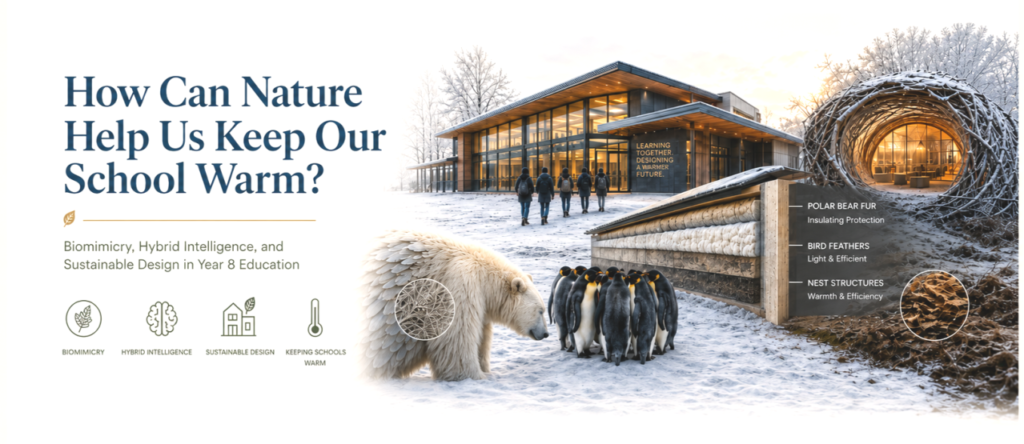
During a short sabbatical, I’ve been developing a Year 8 STEAM unit titled “How Can Nature Help Us Keep Our School Warm?” The unit uses biomimicry as a pedagogical approach to help students investigate how living systems retain warmth, reduce heat loss, and adapt to cold environments. Students then transfer these biological strategies into human-centered design proposals for improving thermal comfort within school spaces.
The unit invites students to explore natural warming strategies, including the following:
- Polar bear fur: Traps air to support insulation
- Bird feathers: Layered structures to retain warmth
- Penguin huddling: Reduces heat loss through collective behavior
- Animal nests: Create protected and insulated spaces
- Forest floor systems: Use layered organic material to protect and regulate ground temperature
The project is structured through my Hybrid Intelligence Framework, which draws on the Gaian Cognitive Spectrum Model’s distinction between Divergent, Convergent, Bridge, and Synthetic forms of intelligence, all of which I have discussed in previous articles.
Briefly:
- Divergent Intelligence: Students investigate multiple natural strategies for retaining warmth.
- Convergent Intelligence: They identify one school-based thermal comfort problem and select a relevant biological model.
- Bridge Intelligence: They connect biology, heat transfer, material properties, sustainability, ethics, and community needs.
- Synthetic Intelligence: They design, prototype, test, evaluate, and refine a nature-inspired solution.
Artificial intelligence is positioned as a cognitive partner rather than a substitute for student thinking. Students may use AI to generate research questions, clarify scientific concepts, or compare design possibilities. Still, as part of their assessment, they must document their own observations, justify their design decisions, test their prototypes, and reflect on the evidence they collect. No AI output is graded because its contribution only informs subsequent learning rather than replacing it.
This unit teaches several concepts, including heat transfer, insulation, adaptation, and sustainable design. It also helps students understand that complex problems require interdisciplinary thinking. By studying how nature manages warmth, students begin to see biological systems as sources of design intelligence and innovation.
This project demonstrates how biomimicry can transform a familiar seasonal issue into a meaningful STEAM inquiry. It encourages students to move from observation to interpretation, from research to design, and from technological consumption to thoughtful, evidence-based innovation.
The approach is informed by the Gaian Cognitive Spectrum Model, biomimicry education resources from AskNature / Biomimicry Institute, and Harvard Project Zero’s Visible Thinking Routines, particularly in the use of observation, interpretation, and questioning to make student thinking visible.
Innovation does not necessarily begin with adding more technology. Instead, it begins with learning to observe the intelligence already present in the natural world.
If you would like to see the full unit plan, lesson sequence, assessment structure, and student portfolio format in more detail, please post a comment below.
References:
- Jessica Sanchez — Gaian Cognitive Spectrum Model
- AskNature / Biomimicry Institute – Educator resources and middle school biomimicry design challenges
- Biomimicry Institute – What is Biomimicry?
- Harvard Project Zero – See, Think, Wonder and Visible Thinking routines.
Isabel Perez is a contemporary STEAM educator fusing innovative pedagogy with nascent technologies to create high-impact learning environments. Her programs combine flexible space for intellectual curiosity, proven teaching strategies, and novel assessment frameworks to maximize engagement, empower students, and help teachers drive stronger academic outcomes.
#Biomimicry#SustainabilityEducation#STEAMEducation#AIinEducation#ProjectBasedLearning
Originally published May 25th, 2026, on LinkedIn (check Isabel Perez profile page)